August, 15th 2013 was Debian's 20th anniversary. The Debian Project is a massive community-driven open-source project devoted to a single goal: build a free Linux operating system. Debian is well-known for maintaining strictly guarded policies and principles to remain the most stable and secure Linux distribution.
While many folks regularly use Debian operating system as end-users, system admins or developers, you may not know the interesting history and facts behind Debian itself.
Below are a list of things that you may not know about Debian GNU/Linux. The statistics presented here are up-to-date as of April 30, 2013 (thanks to ohloh.net).
1. Debian is the largest non-commercial Linux distribution, leading to a number of offshoot projects such as Ubuntu, Xandros, Knoppix, etc.
2. The name "Debian" comes from the names of the founder of the Debian project, Ian Murdock, and his then girlfriend, Debra.
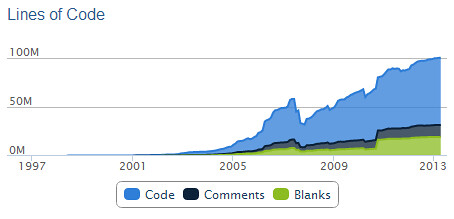
3. The total number of source lines of the Debian project is approximately 100 million, of which 68.5% are actual code, discounting blank lines and comment lines.
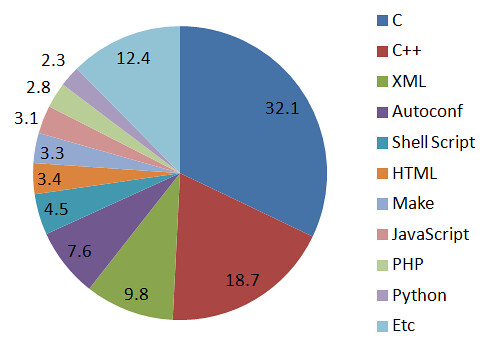
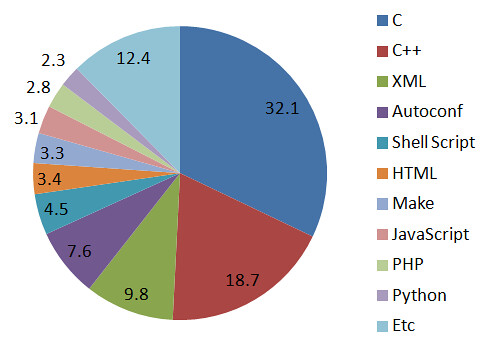
4. The Debian project is written in 70 different languages. The most popular language is C (32.1%). The complete breakdown of language distribution (in terms of total lines) is shown below.
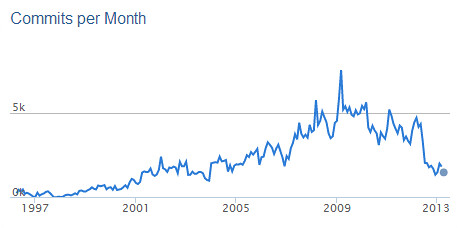
5. The Debian project has had a total of 470,142 commits made by 4,752 contributors since 1996. During this time, 1.4 million files were modified.
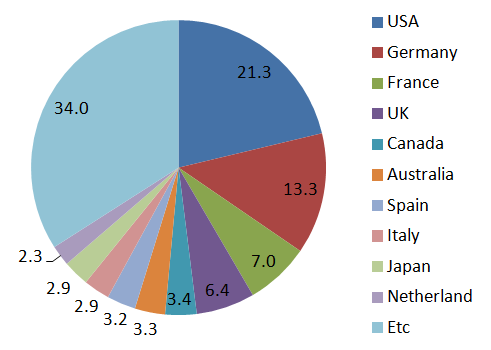
6. Debian contributors are distributed over 587 distinct geographic locations worldwide. As shown below in geography breakdown, the country where the most contributors are located is USA (21.3%).
7. The all-time most prolific contributor of the Debian project is Jonas Smedegaard, who has been an official Debian developer since 2001. Jonas has committed 9,349 times over more than a decade.
8. The code names of Debian releases are the names of characters from the animation film Toy Story. The unstable, development distribution is called "sid", named after the emotionally unstable next-door neighbor kid who regularly destroyed toys.
9. According to the industry standard COnstructive COst MOdel (COCOMO), the cost estimate for developing the entire code base of the Debian project is 1.2 billion US dollars, or 22,984 person-years' efforts.
10. The five most popular pages of Debian Wiki (besides the front page) are NetworkConfiguration, DebianWheezy, NvidiaGraphicsDrivers, WiFi/HowToUse, and Skype.
11. Debian 1.0 was never released due to the mistake of a CD vendor accidentally shipping an (unbootable!) early development release of Debian as Debian 1.0. This premature Debian release was deprecated afterward. The very first (properly packaged) Debian release was Debian 1.1 Buzz.
If you know any other interesting facts about Debian, feel free to share it in the comment section.
Happy 20th Birthday, Debian!
References:
- http://www.debian.org/doc/manuals/project-history/
- http://en.wikipedia.org/wiki/Debian
- http://www.debian.org/devel/developers.coords
- http://www.ohloh.net/p/debian
- https://wiki.debian.org/PageHits
- https://db.debian.org/
Subscribe to Xmodulo
Do you want to receive Linux FAQs, detailed tutorials and tips published at Xmodulo? Enter your email address below, and we will deliver our Linux posts straight to your email box, for free. Delivery powered by Google Feedburner.
Support Xmodulo
Did you find this tutorial helpful? Then please be generous and support Xmodulo!


Subscribe to Xmodulo
Support Xmodulo
Claiming to be a FAQ it should probably it might be worth mentioning that Ian and Debra divorced in 2007. Or better yet, dropping the marriage part. Your pick.
See http://en.wikipedia.org/wiki/Ian_Murdock for reference.
Thanks. Post updated.
It's interesting that Debian's birthday and India's Independence Day are both on 15 August!
Thanks for sharing that interesting post.
But for #6, from the map it looks like Europe has much more contributors than the US. Especially Germany seems to have a lot.
I think the graph shows the distinct locations (cities?) of contributors, but not how many contributors there are in each. According to db.debian.org, the number of contributors are US: 377, DE: 236, FR, 125, UK: 114, etc.
Ok, so they split Europe in different countries. Because in order of that data Germany and France together alone have nearly as much as the USA. Together with the other European countries, the map is correct. There are much more contributors in Europe then.
If I'm not mistaken, in Germany they have a couple of cities who have deployed linux in their local councils, and they would quite possibly employ people who might be making regular contributions.
Thanks, that was entertaining to read.
In 4 and 5, what are you taking as Debian? The .deb package files, the actual packages or what? All Debian does is pull together software and package it in a way that is easy for users to use. I'd imagine that it on its own isn't that big.
If you are interested in knowing what Debian developers are working on, check out: http://www.debian.org/devel/ I cannot speak on their behalf.
As for statistics, ohloh.net pulls analytics from the following list of source code repositories:
http://www.ohloh.net/p/debian/enlistments
Interesting read thank you. A really important fact is the naming of the different versions are all related to toy story. Although anyone who's heard of Debian probably already knows that :)
have a great day
Dave
Hi, just curious as a retired programmer, I find the number kind of strange. As most programmers produce about 10 lines of debuged code per day, Jonas has produced:
7,000,000 over 10 years or about 700,000 lines per year that's about 1917 per day (not counting leap years). Rather prolific! Something smells here. I have doubt that Jonas is a major contributor and a good asset for Debian, but give me a break!
Jack
That is I have NO doubt, not that I'm doubting any of his abilities...But 79 lines an hour, that's 1.3 lines a minute! Astounding!
Jack
I am with you on that. :)
Ohloh data is flawed: It lists a lot of code which I _merged_ as _originating_ from me.
There are many styles of handling VCS - and clearly Ohloh makes false assumptions about that.
Thanks, Dan, for putting this together, and thanks to Surya Fajri (kilelme) for pointing me to it.
Thanks Jonas for clarifying this. So I guess mentioning total code lines may not be necessary here. I updated it and also your developer profile URL.
This article is missing the list of Debian ports to other architectures:
http://www.debian.org/ports/index.en.html
and the quantity of Debian packages:
http://www.kirya.net/2009/01/counting-debian-source-packages/
http://en.wikipedia.org/wiki/Debian
You may want to explore the UDD: https://wiki.debian.org/UltimateDebianDatabase
Isn't Sid a referance to Sid Vicious?
Sid is Andy's neighbor: https://en.wikipedia.org/wiki/Toy_Story
My account is jonass only at some places. If still relevant to mention me at all, I suggest not mention that account name, and to refer this URL linking to most possible Debian-related resources: http://portfolio.debian.net/result?email=js@debian.org&nonddemail=dr@jones.dk
I'm sad to see that the commits per month has fallen such a large amount in the last 3-4 years. I hope that trend does not continue.
Some of that may have been packaging things that weren't already packaged. Today, there isn't really much by way of software left that isn't packaged for Debian. If a package is in Ubuntu, it's also almost certainly in Debian.
Why fix (or commit) what isn't broken? It may be that Debian is simply converging towards a beautifully stable OS, needing only updates to accommodate newer technologies.
Perhaps they're moving closer to upstream now that their releases are somewhat more frequent. You'll notice the big downward spikes coincide with release freezes.
Named after his then girlfriend. Classic mistake. But it's good to hear that someone could do something so great and still maintain a personal life.
Shall I get a tattoo that says 'Debra' or create an awesome OS named after her? Correct choice made.
The good news is if he is ever dissatisfied with direction Debian goes in, he can always fork it to create the linux distribution "Justian".
What, exactly, are they talking about in points 3-5? All code for anything they package? They aren't actually writing the vast majority of that code.
Debian maintains tons of patches for each package, and I've seen Debian developers/packagers notice bugs and patch them before upstream was able to. In my experience as upstream, they also tend to send us these patches, which helps a lot with development.
I've seen people grumble about excessively patched Debian applications, but it's cool that they send patches to upstream.
Yeah, it went even so far that Debian demanded to have the last word and control on the user experience with apps ... Mozilla was not amused as they try to provide a defined and consistent user experience themself for their apps. From this fight over "who has the last word on the app" the infamous iceweasel/firefox split resulted.
seems like an odd demand--Debian isn't like gnome or pantheon, they have no business controlling application experiences :/ Makes me wary of using Debian, though I've been curious about synaptic and apt for a while.